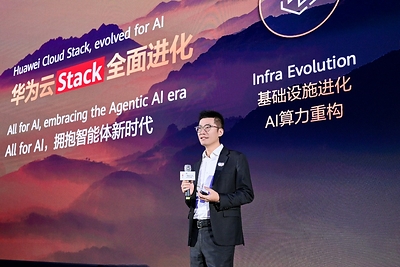
SHANGHAI, Sept. 18, 2026 /PRNewswire/ -- At HUAWEI CONNECT 2026, Huawei hosted the Huawei Cloud Summit under the theme "Agentic Hybrid Cloud: Powering a New Era of Intelligence." Antonony Gu, President of Huawei Hybrid Cloud, delivered a keynote speech at the summit, discussing the changes driven by AI agents, Huawei Cloud Stack's evolution across four key areas—cloud infrastructure, data, AI, and ecosystem—guided by the principle of "All for AI", and its commitment to helping enterprises embrace the agentic AI era.
AI agents are among the most significant developments in AI today. Agents for coding, workplaces, design, customer service, marketing, and more are rapidly redefining how businesses get done. Antonony Gu highlighted that the rapid adoption of AI agents is driving three fundamental changes:
Addressing these changes, Huawei Cloud has introduced an AI agent-ready hybrid cloud architectureNext, comprising four key capabilities: an agile, elastic cloud infrastructure designed for continuous evolution and unified general-purpose and AI compute; an AI-native capability hub that connects data, compute, and tokens; an agent-native enablement platform for developing and running AI agents at scale; and intelligent operations and end-to-end security capabilities covering the entire AI agent lifecycle. Antonony Gu emphasized, "As AI agent adoption continues to accelerate over the next three to five years, a deterministic hybrid cloud architecture is a clear path forward for enterprises in the agentic world."
As the agentic AI era approaches, Huawei Cloud Stack is evolving across four key areas: infrastructure, data, AI, and ecosystem.
The agentic AI era is opening up new possibilities for enterprises. Looking ahead, Huawei Cloud Stack, guided by the principle of "All for AI," will continue to invest heavily in Agentic Infra, data, and AI. Together with partners, Huawei Cloud Stack will foster an open ecosystem, helping enterprises build, use, and manage cloud environments efficiently and bring AI into production across industries.
 View original content to download multimedia:https://www.prnewswire.co.uk/news-releases/antonony-gu-huawei-cloud-all-for-ai-huawei-cloud-stack-powers-a-new-era-of-intelligence-302883061.html

Die Exzellenzstrategie von Bund und Ländern stellt die Weichen für die nächste Förderperiode – und verschiebt die Gewichte im deutschen Wissenschaftssystem. Zu den bundesweit fünf neuen Exzellenzstandorten gehören die Technische Universität Darmstadt, die Goethe-Universität Frankfurt und die Johannes Gutenberg-Universität Mainz, die sich als Allianz der Rhein-Main-Universitäten (RMU) durchgesetzt haben. Ebenfalls erfolgreich waren in Nordrhein-Westfalen die Universität zu Köln sowie der Verbund Ruhr Innovation Lab aus TU Dortmund und Ruhr-Universität Bochum.
Für Hessen ist die Entscheidung ein Durchbruch: Erstmals tragen Universitäten des Landes ab 2027 den Titel „Exzellenzuniversität“. Die RMU-Allianz erhält nach Angaben des hessischen Wissenschaftsministeriums über sieben Jahre eine Förderung von insgesamt bis zu 155 Millionen Euro, finanziert zu 75 Prozent vom Bund. Wissenschaftsminister Timon Gremmels spricht von den ersten Exzellenzunis in Hessen und zugleich vom ersten länderübergreifenden Verbund in der Exzellenzstrategie. Ministerpräsident Boris Rhein bezeichnet den Titel als Meilenstein für die Forschungslandschaft des Landes. Ein mittelhessischer Verbund aus den Universitäten Gießen und Marburg blieb im Wettbewerb dagegen ohne Erfolg.
Auch Nordrhein-Westfalen stärkt seine Rolle als Hochburg der Spitzenforschung. Neben der Universität Köln, die den begehrten Status nach einer früheren Förderphase von 2012 bis 2019 zurückerhält, steigt der Verbund aus TU Dortmund und Ruhr-Uni Bochum als Ruhr Innovation Lab in den Kreis der Exzellenzuniversitäten auf. Nach Angaben des Düsseldorfer Wissenschaftsministeriums baut das Land damit seine Führungsposition aus. Die Universität Bonn und die RWTH Aachen hatten ihren Exzellenzstatus bereits im Frühjahr verteidigt, sodass NRW künftig mit vier Standorten vertreten ist. Ministerpräsident Hendrik Wüst wertet dies insbesondere als Signal für die internationale Sichtbarkeit des Ruhrgebiets als Wissenschafts- und Innovationsstandort.
In Bonn gaben Bundesforschungsministerin Dorothee Bär und der niedersächsische Wissenschaftsminister Falko Mohrs als Vize-Vorsitzender der Gemeinsamen Wissenschaftskonferenz (GWK) neben den Standorten in Hessen und NRW auch die Universitäten Freiburg und Jena als neue Exzellenzunis bekannt. Für Einzeluniversitäten sieht das Programm Fördermittel von bis zu 15 Millionen Euro pro Jahr vor, bei Verbünden wie der Rhein-Main-Allianz oder dem Ruhr Innovation Lab können es bis zu 28 Millionen Euro sein. Damit wächst die Riege der Exzellenzuniversitäten, deren bisher neun Standorte – darunter Aachen, Bonn, Dresden, Hamburg, Heidelberg, Karlsruhe, München, Tübingen sowie die Berlin University Alliance – ihre Förderung bereits im Frühjahr um weitere sieben Jahre verlängert hatten. Der Titel ist jeweils an regelmäßige Überprüfungen der Fördervoraussetzungen geknüpft.



