DEEPX ultra-low-power NPUs to be integrated into AAEON's industrial computing lineup, accelerating the deployment of commercial Physical AI across global industries.
TAIPEI, June 2, 2026 /PRNewswire/ -- At COMPUTEX TAIPEI 2026, DEEPX Inc., an ultra-low-power Physical AI semiconductor company, announced a strategic three-year Global Mass Production Cooperation agreement with AAEON Technology Inc., a leading provider of advanced industrial and embedded AI computing platforms. The agreement, signed by both company CEOs, establishes a commercialization pipeline to integrate DEEPX's high-performance Neural Processing Units (NPUs) into AAEON's flagship product lines, including industrial computers (IPCs), Single Board Computers (SBCs), and edge gateways.
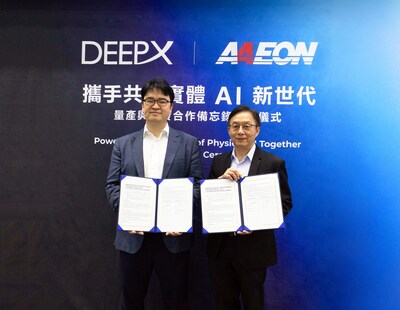
Transitioning beyond technical validation, the partnership focuses on scaling hardware into mass-producible products. The companies will manufacture standard form factor AI accelerator modules—including M.2, mPCIe, PCIe cards, and COM Express boards—alongside custom OEM/ODM edge AI products. DEEPX will deliver its AI chipsets, dedicated compilers, and the DXNN SDK, while AAEON will lead hardware design and specification matching for sectors such as smart factories, autonomous robotics (AMR/AGV), smart cities, and edge security.
The agreement builds on established market traction. Platforms combining AAEON hardware and DEEPX semiconductors secured initial global pre-orders immediately following official certification in December 2025. Real-world verification with major global customers has validated exceptional power-to-performance ratios and system stability, accelerating the transition to large-scale production.
This commercial momentum aligns with DEEPX's rapid ecosystem expansion, which has doubled from 15 partners at COMPUTEX 2025 to more than 30 global partners in 2026. Leveraging AAEON's extensive global distribution networks and the ASUS Group, the alliance will jointly pursue market expansion at major global exhibitions, including CES and Embedded World.
Executive Commentary
Lokwon Kim, CEO of DEEPX:
"AAEON combines a proven hardware platform with the ASUS Group's extensive distribution network. This mass production agreement enables DEEPX to deploy stable, high-efficiency intelligence directly inside the edge devices at the heart of the global industrial market."
Howard Lin, CEO of AAEON Technology:
"DEEPX's NPU architecture perfectly balances power efficiency and high performance. By integrating AAEON's global hardware platforms with DEEPX's advanced silicon, we are well-positioned to deliver robust, transformative edge AI solutions with long-term product availability across industrial applications."
Photo - https://mma.prnewswire.com/media/2993045/2026_0602_DEEPX_x_AAEON_MOU_News_Banner_0111.jpg
Logo - https://mma.prnewswire.com/media/2857355/DEEPX_Logo.jpg
 View original content:https://www.prnewswire.co.uk/news-releases/deepx-announces-global-physical-ai-mass-production-partnership-with-aaeon-at-computex-2026-302788248.html

Die von US-Präsident Donald Trump angekündigten Zölle von 25 Prozent auf Neuwagenimporte aus der Europäischen Union würden nach Einschätzung von Branchenexperten vor allem die deutsche Autoindustrie treffen. Berechnungen des Center Automotive Research (CAR) in Bochum zufolge kämen allein auf die Autoproduktion in Deutschland zusätzliche Belastungen von rund 2,5 Milliarden Euro pro Jahr zu. Hinzu kämen weitere Kosten für US-Exporte deutscher Hersteller aus Werken in anderen EU-Staaten.
Obwohl sich die Maßnahmen formal gegen die gesamte EU richten, sieht CAR-Direktor Ferdinand Dudenhöffer insbesondere Deutschland im Visier Washingtons. Die Exporte anderer ausländischer Autobauer in die USA seien „unwesentlich“, sagte er und sprach mit Blick auf die neuen Zoll-Drohungen vom möglichen Beginn eines „Wirtschaftskriegs gegen Deutschland“. Die Maßnahmen würden die Hersteller jedoch unterschiedlich hart treffen, abhängig von ihrer Produktionsstruktur und Präsenz in den Vereinigten Staaten.
Relativ besser gestellt wären demnach Konzerne wie BMW und Mercedes-Benz, die über umfangreiche Produktionskapazitäten in den USA verfügen. In ihren US-Werken fertigen sie vor allem SUV-Modelle, die den Großteil ihrer Verkäufe auf dem US-Markt ausmachen. Diese lokale Produktion wirkt nach Einschätzung Dudenhöffers wie ein „Zollschutz“, weil in den USA montierte Fahrzeuge nicht unter die geplanten Importzölle auf Neuwagen aus der EU fallen würden.
Deutlich verwundbarer wären dagegen Marken wie Audi und Porsche, die ihre Fahrzeuge bislang weitgehend aus Europa in die USA liefern. Für sie könnten die neuen Einfuhrabgaben ein Anreiz sein, Pläne zum Aufbau eigener Produktionsstätten in den Vereinigten Staaten zu beschleunigen. Vollständig auffangen können die Hersteller die zusätzlichen Kosten nach Einschätzung des CAR-Instituts jedoch nicht. Ein Teil der Belastungen dürfte über Preiserhöhungen an die US-Käufer weitergegeben werden. Dank der starken Markenbindung rechnet Dudenhöffer zwar nicht mit einem abrupten Nachfrageeinbruch, die deutschen Autobauer stünden jedoch vor der Herausforderung, ihre Preissetzung und Standortstrategie zügig an die neue handelspolitische Lage anzupassen.



