SEOUL, South Korea, Oct. 6, 2026 /PRNewswire/ -- HD Hyundai has delivered the world's first "Lashing-Free" container ship, introducing a new concept that eliminates the need for workers to manually secure containers on board.
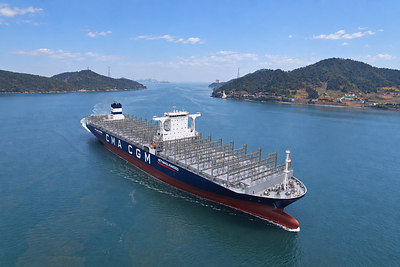
HD Hyundai announced on Tuesday, October 6, that it recently delivered a 13,000-TEU container ship for a French shipping company, with its hybrid-type Lashing-Free technology partially applied.
HD Hyundai Heavy Industries independently developed and validated all key components of the Lashing-Free technology, while HD Hyundai Samho was responsible for the detailed design and construction of the vessel incorporating the system.
The Lashing-Free container ship removes the need for manual container lashing, which has traditionally been carried out by workers using lashing equipment on large container vessels. It also incorporates technologies designed to prevent cargo loss and maximize logistics efficiency.
The vessel extends the cell guides, which support containers stacked vertically in alignment inside the cargo hold, all the way above deck.
With conventional large hatch covers, however, the extended cell guides would be obstructed, preventing them from reaching above deck. To overcome this structural limitation, HD Hyundai Heavy Industries developed a standardized portable bench that can be installed between the cell guides.
The portable bench is built to the same dimensions as a 40-foot container, allowing it to be handled using the same port cranes used to load and unload containers. The technology is expected to play a key role in accelerating automation and unmanned operations across the broader logistics network connecting land and sea, including container terminals.
HD Hyundai Heavy Industries has also developed a Twistlock Rooting System, which securely fastens containers stowed outside the cell guide area to the vessel's structure.
As a result, the Lashing-Free container ship can carry over 10% additional cargo weight on deck compared with conventional vessels of the same type. The system also provides stable support for containers even in rough seas and strong winds, helping prevent cargo loss, enhance maritime safety and reduce the risk of marine pollution.
Sea trials conducted by HD Hyundai in September showed that the Lashing-Free system significantly reduces vibration during operation compared with conventional designs using hatch covers and lashing bridges. The company is also developing a next-generation version of the technology incorporating weathertight features.
"We plan to expand the application of this new container transportation technology to small- and medium-sized vessels," said Hongryeul Ryu, Senior Executive Vice President and Chief Technology Officer at HD Hyundai Heavy Industries. "By continuing to develop differentiated technologies that deliver tangible value to customers in areas such as safety, loading efficiency and automation, we aim to further strengthen our ability to secure new orders."
Meanwhile, HD Hyundai Heavy Industries' Lashing-Free technology was introduced as a representative Korean technology related to "measures to prevent the loss of containers at sea" at the 10th session of the International Maritime Organization's Sub-Committee on Carriage of Cargoes and Containers (CCC) in 2024. The technology has secured multiple intellectual property registrations in Korea and overseas and was also selected as a recipient of this year's IR52 Jang Young-shil Award.

 View original content to download multimedia:https://www.prnewswire.co.uk/news-releases/hd-hyundai-delivers-worlds-first-lashing-free-container-ship-302899537.html

Die Innenministerkonferenz (IMK) der Länder hat ihr seit 1954 praktiziertes Einstimmigkeitsprinzip aufgegeben und setzt künftig auf Mehrheitsentscheidungen. Beschlüsse gelten nun als gemeinsame Linie der Länder, wenn mindestens 13 der 16 Innenministerinnen und Innenminister zustimmen. Die Neuregelung wurde nach Angaben eines Sprechers des Gremiums im schriftlichen Umlaufverfahren beschlossen und gilt ab sofort.
Auslöser für den Kurswechsel ist die Möglichkeit, dass in kommenden Landesregierungen die AfD das Innenressort übernehmen könnte. In Sachsen-Anhalt hatte ihr Spitzenkandidat Ulrich Siegmund zuletzt erklärt, er wolle sich im Dezember zum Ministerpräsidenten wählen lassen – ein Schritt, der eine Regierungsbildung mit AfD-Beteiligung als realistische Option erscheinen lässt. Nach der bisherigen Praxis hätte ein Land mit einem AfD-Innenminister im Zweifel IMK-Beschlüsse blockieren können.
Mit der Abkehr von der Einstimmigkeit wollen die übrigen Länder nach übereinstimmenden Angaben verhindern, dass ein einzelnes Ressort – unabhängig von der parteipolitischen Farbe – zentrale Positionierungen in Fragen der inneren Sicherheit ausbremst. Bislang sollte die Einstimmigkeit sicherstellen, dass kein Land bei sensiblen Themen überstimmt wird; ein Veto oder auch eine Enthaltung konnten Beschlüsse stoppen, abweichende Positionen wurden im Protokoll dokumentiert. Künftig soll bereits eine breite, aber nicht mehr vollständige Zustimmung als ausreichend gelten, um einen länderübergreifenden Standpunkt zu formulieren.
Formal bleibt die IMK ein informelles Gremium ohne gesetzliche Grundlage. Sie ist weder im Grundgesetz noch in Bundes- oder Landesgesetzen verankert und verfügt über keine geschriebene Geschäftsordnung. Gleichwohl entfalten ihre Beschlüsse beträchtliche Wirkung, weil sie in den Ländern politisch aufgegriffen und umgesetzt werden. Mit der nun eingeführten Mehrheitsregel verschiebt sich das Machtgefüge innerhalb dieser Runde: Konsens bleibt möglich, ist aber nicht mehr Voraussetzung dafür, dass die Innenminister gemeinsam handeln.



