FREIBURG, Germany, Oct. 1, 2026 /PRNewswire/ -- Hoymiles, a global provider of solar energy and storage solutions, supported the solar panel upcycling event in Freiburg, Germany, for the third consecutive year, providing 300 microinverters for 300 plug-in photovoltaic (PV) systems. More than 500 citizens along with local organizations and public representatives took part in the event, helping give 600 used solar panels a second life as plug-in solar systems for homes.
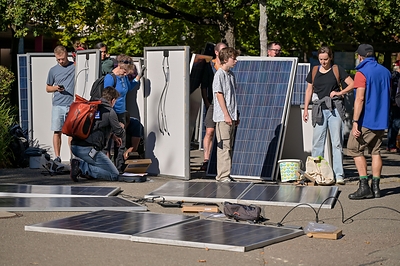
Giving solar panels a second life
Organized by German non-profit organization BalkonSolar e.V., the initiative demonstrates how solar equipment that remains functional after its first application can be reused in new settings.
During the event, participants assembled 300 plug-in PV systems, each consisting of two used PV modules, a microinverter, and the necessary cabling. The 600 panels had previously operated for 13 years on the roof of a toothbrush factory in the Black Forest. According to BalkonSolar e.V., around 5% of the panels showed defects, while the majority remained suitable for immediate further use. The completed systems were then provided to participating citizens free of charge, supported by funding from the City of Freiburg's Solar Summer program.
"Old solar panels do not have to be thrown away, but can be repurposed once they come down from a roof and easily and safely turned into plug-in PV systems", said Sebastian Müller, chair of the non profit BalkonSolar Association.
Three years of supporting solar upcycling
The Freiburg initiative marks Hoymiles' third consecutive year of supporting solar panel upcycling events in Germany. Since first joining the initiative in 2024, Hoymiles has continued to contribute microinverter technology to community-led projects.
"We are proud to support this initiative for the third consecutive year and to see more citizens take part in giving used solar panels a second life," said Hoymiles CEO Dr. Yang Bo. "Renewable energy is not only about generating clean power, but also about using resources responsibly."
From solar innovation to sustainable action
Hoymiles microinverters are well suited to upcycling applications because each module can operate independently with its own maximum power point tracking. This helps maintain system performance even when used modules have different conditions or orientations. By supplying the microinverters, Hoymiles provided the key component needed to convert previously used rooftop modules into complete, safe plug-in solar systems.
The initiative reflects Hoymiles' broader commitment to sustainability and its "Open Energy for All" vision, which aims to make smart solar energy more inclusive, practical and accessible.
The BalkonSolar Verein is a registered non-profit, full of passionate Plug-in-PV enthusiasts from the German-speaking region with roots in Freiburg with more than 300 members.

 View original content to download multimedia:https://www.prnewswire.co.uk/news-releases/hoymiles-supports-solar-sustainability-for-third-consecutive-year-with-freiburg-upcycling-world-record-302895688.html

Die Exzellenzstrategie von Bund und Ländern stellt die Weichen für die nächste Förderperiode – und verschiebt die Gewichte im deutschen Wissenschaftssystem. Zu den bundesweit fünf neuen Exzellenzstandorten gehören die Technische Universität Darmstadt, die Goethe-Universität Frankfurt und die Johannes Gutenberg-Universität Mainz, die sich als Allianz der Rhein-Main-Universitäten (RMU) durchgesetzt haben. Ebenfalls erfolgreich waren in Nordrhein-Westfalen die Universität zu Köln sowie der Verbund Ruhr Innovation Lab aus TU Dortmund und Ruhr-Universität Bochum.
Für Hessen ist die Entscheidung ein Durchbruch: Erstmals tragen Universitäten des Landes ab 2027 den Titel „Exzellenzuniversität“. Die RMU-Allianz erhält nach Angaben des hessischen Wissenschaftsministeriums über sieben Jahre eine Förderung von insgesamt bis zu 155 Millionen Euro, finanziert zu 75 Prozent vom Bund. Wissenschaftsminister Timon Gremmels spricht von den ersten Exzellenzunis in Hessen und zugleich vom ersten länderübergreifenden Verbund in der Exzellenzstrategie. Ministerpräsident Boris Rhein bezeichnet den Titel als Meilenstein für die Forschungslandschaft des Landes. Ein mittelhessischer Verbund aus den Universitäten Gießen und Marburg blieb im Wettbewerb dagegen ohne Erfolg.
Auch Nordrhein-Westfalen stärkt seine Rolle als Hochburg der Spitzenforschung. Neben der Universität Köln, die den begehrten Status nach einer früheren Förderphase von 2012 bis 2019 zurückerhält, steigt der Verbund aus TU Dortmund und Ruhr-Uni Bochum als Ruhr Innovation Lab in den Kreis der Exzellenzuniversitäten auf. Nach Angaben des Düsseldorfer Wissenschaftsministeriums baut das Land damit seine Führungsposition aus. Die Universität Bonn und die RWTH Aachen hatten ihren Exzellenzstatus bereits im Frühjahr verteidigt, sodass NRW künftig mit vier Standorten vertreten ist. Ministerpräsident Hendrik Wüst wertet dies insbesondere als Signal für die internationale Sichtbarkeit des Ruhrgebiets als Wissenschafts- und Innovationsstandort.
In Bonn gaben Bundesforschungsministerin Dorothee Bär und der niedersächsische Wissenschaftsminister Falko Mohrs als Vize-Vorsitzender der Gemeinsamen Wissenschaftskonferenz (GWK) neben den Standorten in Hessen und NRW auch die Universitäten Freiburg und Jena als neue Exzellenzunis bekannt. Für Einzeluniversitäten sieht das Programm Fördermittel von bis zu 15 Millionen Euro pro Jahr vor, bei Verbünden wie der Rhein-Main-Allianz oder dem Ruhr Innovation Lab können es bis zu 28 Millionen Euro sein. Damit wächst die Riege der Exzellenzuniversitäten, deren bisher neun Standorte – darunter Aachen, Bonn, Dresden, Hamburg, Heidelberg, Karlsruhe, München, Tübingen sowie die Berlin University Alliance – ihre Förderung bereits im Frühjahr um weitere sieben Jahre verlängert hatten. Der Titel ist jeweils an regelmäßige Überprüfungen der Fördervoraussetzungen geknüpft.



