CLARK, N.J., Oct. 12, 2026 /PRNewswire/ -- GEP Global Supply Chain Volatility Index — a leading indicator tracking demand conditions, shortages, transportation costs, inventories and backlogs, based on a monthly survey of 27,000 businesses — showed global manufacturers ramping up purchases of raw materials and components in September as underlying demand strengthened.
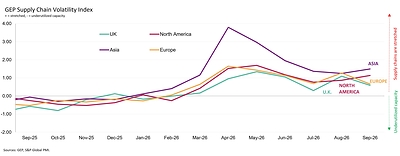
Global input demand growth rose to its strongest since May and was close to its 2026 high, signaling firmer manufacturing activity heading into the fourth quarter. Purchasing strengthened across North America, Asia and Europe, with particularly strong increases in the United States, Germany, Taiwan and South Korea.
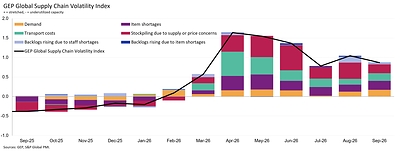
At the same time, supply pressures intensified. Shortages increased for the first time since May, while global transportation costs also rose. Shortages of oil and oil-based products were particularly acute, creating renewed cost and availability pressures for manufacturers.
"Manufacturers are buying more because demand is strengthening, but they're doing so at a time when shortages and transportation costs are starting to rise again," said John Piatek, vice president, GEP Consulting. "For companies, that means the priority shifts from simply protecting inventory to securing supply and controlling costs. If demand continues to build through the fourth quarter, businesses that wait will face tighter availability and higher input costs."
Interpreting the data:
Index > 0, supply chain capacity is being stretched. The further above 0, the more stretched supply chains are.
Index < 0, supply chain capacity is being underutilized. The further below 0, the more underutilized supply chains are.
SEPTEMBER 2026 REGIONAL KEY FINDINGS
SEPTEMBER 2026 KEY FINDINGS
For more information, visit www.gep.com/volatility.
Note: Full historical data dating back to January 2005 is available for subscription. Please contact economics@spglobal.com.
The next release of the GEP Global Supply Chain Volatility Index will be 8 a.m. ET, Nov. 11, 2026.
About the GEP Global Supply Chain Volatility Index
The GEP Global Supply Chain Volatility Index is produced by S&P Global and GEP. It is derived from S&P Global's PMI® surveys, sent to companies in over 40 countries, totaling around 27,000 companies. The headline figure is a weighted sum of six sub-indices derived from PMI data, PMI Comments Trackers and PMI Commodity Price & Supply Indicators compiled by S&P Global.
A Supply Chain Volatility Index is also published at a regional level for Europe, Asia, North America and the U.K. For more information about the methodology, click here.
Media Contacts
Derek Creevey
Director, Public Relations
GEP
Phone: +1 646-276-4579
Email: derek.creevey@gep.com
Joe Hayes
Senior Principal Economist
S&P Global Market Intelligence
Phone: +44-1344-328-099
Email: joe.hayes@spglobal.com
 View original content to download multimedia:https://www.prnewswire.co.uk/news-releases/manufacturers-ramp-up-purchasing-in-september-as-global-demand-strengthens-gep-global-supply-chain-volatility-index-302905220.html

Im Magdeburger Landtag steht ein Einschnitt in der bundesdeutschen Parlamentsgeschichte bevor: Erstmals könnte ein Abgeordneter der AfD das Amt des Landtagspräsidenten übernehmen. Der 35-jährige Tobias Rausch, seit 2016 Mitglied des Landtags von Sachsen-Anhalt und Generalsekretär der AfD im Bundesland, geht mit einer komfortablen Mehrheit in die konstituierende Sitzung. Nach ihrem klaren Wahlsieg stellt die AfD künftig 39 der 83 Abgeordneten und ist damit die mit Abstand stärkste Fraktion.
Den entscheidenden Schub liefert das Bündnis mit dem Bündnis Sahra Wagenknecht (BSW). Die fünf BSW-Abgeordneten wollen geschlossen für Rausch stimmen und kommen gemeinsam mit der AfD auf 44 Stimmen. BSW-Fraktionschef Thomas Schulze verweist auf parlamentarische Gepflogenheiten: Als stärkste Fraktion habe die AfD laut Geschäftsordnung Anspruch auf den Vorsitz im Parlament. Eine politische Blockbildung gegen die AfD lehnt Schulze ab und präsentiert die Zustimmung zur Wahl des Landtagspräsidenten als Signal eines „neuen Politikstils“.
Die übrigen Fraktionen reagieren gespalten. CDU, SPD, Grüne und Linke verfügen zusammen ebenfalls über 39 Mandate, treten aber nicht geschlossen gegen die AfD an. Die CDU hat angekündigt, sich bei der Wahl zu enthalten – Enthaltungen zählen in diesem Verfahren nicht als abgegebene Stimmen. SPD, Grüne und Linke wollen gegen Rausch stimmen. Spannend bleibt damit vor allem die Frage, ob der AfD-Kandidat über die absehbaren 44 Ja-Stimmen hinaus zusätzliche Unterstützung erhält. Vor der geheimen Abstimmung spekulieren die Lager bereits über mögliche Abweichler; aus der AfD-Spitze heißt es, zusätzliche Stimmen könnten auch aus dem Kreis der erklärten Gegner stammen.
Parallel zur Präsidentenwahl testet die AfD aus, wie weit ihr neuer Einfluss im Landtag reicht. Die Fraktion will die Geschäftsordnung ändern, um neben dem Präsidenten auch einen der drei Vizepräsidentenposten zu besetzen – vorgesehen ist der Abgeordnete Hans-Thomas Tillschneider. In der Vergangenheit sorgten seine Beiträge zur Bildungs- und Kulturpolitik regelmäßig für Kritik in anderen Fraktionen, die den Personalvorschlag daher als Provokation werten dürften. Ob das BSW diese Personalie ebenso mitträgt wie die Wahl von Rausch, ist bislang offen. Unabhängig vom Ausgang der Abstimmungen wird die erste Sitzung des neu gewählten Landtags damit zum Testfall für künftige Zusammenarbeit und Machtarithmetik in Sachsen-Anhalt.




