Joint effort with Airoha Highlights Cross-Generation Interoperability, AI-Powered Energy Saving and Smart Network Diagnostics
HSINCHU, Oct. 6, 2026 /PRNewswire/ -- MediaTek and its subsidiary Airoha Technology are jointly showcasing next-generation fixed and wireless broadband connectivity technologies, spanning Wi-Fi, 5G CPE and PON solutions for emerging AI applications and services, at Network X 2026. Having worked closely with the network communications industry ecosystem, MediaTek is one of the world's leading companies at the forefront of Wi-Fi 8 development and commercialization.
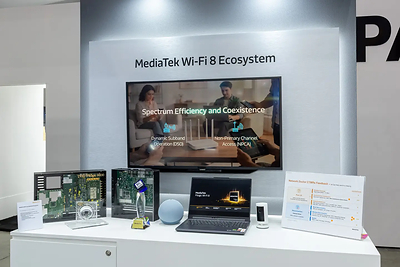
At Network X 2026, MediaTek is showcasing next-generation Enterprise-Grade Wi-Fi 8 technology leveraging the Filogic 8800, a high-performance tri-band flagship router platform designed for AI applications. Unlike previous approaches that focused solely on achieving the highest possible speed for a single device, the Wi-Fi 8 technologies showcased by MediaTek place greater emphasis on the connectivity experience in real-world network environments. Both home and enterprise networks must support the long-term coexistence of Wi-Fi 5, Wi-Fi 6, Wi-Fi 7 and the latest Wi-Fi 8 devices. Through cross-generation network optimization, AI-powered dynamic energy saving and smart network diagnostics, Filogic 8800 improves overall system throughput by up to nearly 100% while reducing system power consumption by 50%, even in environments where new and legacy devices are connected.
Filogic 8800 is shortlisted for the Network X Awards 2026 "Best Indoor Connectivity Solution," demonstrating MediaTek's achievement in transforming Wi-Fi 8 from a next-generation technology specification into an outstanding real-world network experience.
Partnering with the Global Network Communications Ecosystem to Pioneer a Seamless Wi-Fi 8 Transition
As Wi-Fi 7 gradually becomes an important foundation for enterprise and telecom-grade networks, market demand is also shifting beyond peak data rates toward overall system performance, reliability and interoperability among devices from different generations. Since most home and enterprise network environments cannot replace all existing devices overnight, Wi-Fi 5, 6, 7 and 8 devices will coexist on the same network for an extended period of time. As a result, the true value of Wi-Fi 8 lies not in pushing the speed limits of individual new devices, but in maximizing overall network efficiency, stability and user experience when multiple generations of devices connect simultaneously in real-world environments.
Building on its early investment in Wi-Fi 8 technology development and a system and product track record built through long-term, close collaboration with Taiwan's network communications ecosystem, MediaTek has extended its design innovations in Wi-Fi 8 to cross-generation interoperability and real-world commercial deployment. By translating technical specifications into tangible user experiences, MediaTek ensures that next-generation Wi-Fi 8 fully delivers on spectrum efficiency and network performance, even when operating alongside large numbers of legacy Wi-Fi 5/6/7 devices.
Alan Hsu, Corporate Vice President and General Manager of the Intelligent Connectivity Business Unit at MediaTek, said: "MediaTek is one of the global leaders at the forefront of Wi-Fi 8 technological innovation and commercialization, representing a new stage in connectivity that is more intelligent, reliable and efficient. We continue to strengthen our Wi-Fi platforms through cross-generation interoperability, AI-powered energy saving and AI smart network diagnostics, enabling devices across different generations to deliver a better connectivity experience. We work closely with Airoha to integrate product portfolios, and together with global ecosystem partners, we are accelerating the deployment of next-generation connectivity technologies and creating long-term value for telecom operators, enterprises and consumers."
Elevating Overall Network Performance Through Cross-Generation Interoperability
MediaTek DSO+ overcomes the limitations of conventional DSO when legacy clients occupy the Primary Subband, extending dynamic bandwidth allocation to heterogeneous networks. In mixed-generation test environments, overall system throughput can be improved by up to nearly 100%. MediaTek NPCA+ enables Wi-Fi 8 APs to dynamically switch the primary channel to avoid network congestion while maintaining full compatibility with Wi-Fi 7 and Wi-Fi 6 clients. In high-density environments with overlapping networks, network throughput can be improved by up to about 80%.
Driving Network Energy Efficiency and Operational Resilience with AI
MediaTek's AI-assisted power-saving technology dynamically adjusts transmission power based on user behavior and traffic patterns, reducing power consumption by 33% under typical workloads. By further disabling unused frequency bands, overall power consumption can be reduced by up to 50% while maintaining network performance. For the day-to-day operational requirements of telecom operators, AI smart network diagnostics can reduce MTTR (Mean Time to Repair) from approximately 2-4 hours to under one minute, while reducing field service truck rolls by 20%, helping operators improve network operational efficiency and reduce OPEX.
Exhibition: MediaTek + Airoha @ Booth K35
Network X 2026: 13-15 October 2026 @ Messe Wien, Vienna, Austria
 View original content to download multimedia:https://www.prnewswire.co.uk/news-releases/mediatek-showcases-global-wi-fi-8-leadership-with-filogic-8800-at-network-x-2026-302899524.html

Die Bildung einer neuen Landesregierung in Berlin bleibt vorerst ungewiss. Linke, Grüne und SPD konnten sich zweieinhalb Wochen nach der Wahl zum Abgeordnetenhaus weiterhin nicht auf eine gemeinsame Linie im Umgang mit Antisemitismus verständigen. Nach dem dritten sogenannten Vorgespräch verließ die Spitze der drei Parteien am Mittwochnachmittag den Tagungsort ohne öffentliche Stellungnahme. Nach Informationen der Deutschen Presse-Agentur gilt eine Einigung in der Frage als zentrale Voraussetzung, um in formelle Sondierungsgespräche über eine mögliche Regierung unter Führung der Linken einzusteigen.
Bereits für Donnerstag ist ein weiteres Treffen angesetzt. Ziel ist es, in dem seit geraumer Zeit in Berlin heftig diskutierten Themenkomplex voranzukommen. Vor allem Teile der Berliner Linken stehen seit längerem wegen Positionen zu Israel, Palästina und zum Thema Antisemitismus in der Kritik. Dabei geht es insbesondere um Äußerungen einzelner Parteimitglieder, die öffentlich als antisemitisch eingestuft oder entsprechend kritisiert wurden. Ohne eine belastbare Verständigung auf gemeinsame Grundsätze wollen SPD und Grüne nach eigener Darstellung den nächsten Schritt hin zu einem möglichen Regierungsbündnis nicht gehen.
Zusätzliche Brisanz erhielt die Debatte durch eine Wahlparty der Neuköllner Linken am 20. September. Dort waren nach dpa-Informationen sowohl ein Oberhaupt eines arabischstämmigen und zum Teil kriminellen Clans als auch ein umstrittener propalästinensischer Aktivist anwesend. Letzterer soll der Volksfront für die Befreiung Palästinas (PFLP) nahestehen, die von der EU als Terrororganisation eingestuft wird. Der Vorfall hat bei den potenziellen Koalitionspartnern für erhebliche Irritationen gesorgt und den Druck auf die Linke erhöht, sich klarer zu Antisemitismus, Rassismus und organisierter Kriminalität zu positionieren.
SPD und Grüne verlangen vor Beginn offizieller Sondierungen eine verbindliche Verständigung zu diesen Themenfeldern. Sondierungen sind die Vorstufe zu formalen Koalitionsverhandlungen, in denen ein Regierungsprogramm und die Ressortzuschnitte ausgehandelt würden. Ohne Konsens über den künftigen Kurs im Kampf gegen Antisemitismus und im Umgang mit problematischen Milieus in der Stadt bleibt der Weg zu einem möglichen Rot-Grün-Roten Bündnis aber blockiert. Welche Alternativen zu einem solchen Bündnis am Ende realistisch wären, ist bislang offen; entscheidend bleibt vorerst, ob die drei Parteien in der strittigen Grundsatzfrage noch zu einer gemeinsamen Linie finden.