New personal shopper and shelf-side solutions support a more distributed approach to self-service.
SINGAPORE, Sept. 10, 2026 /PRNewswire/ -- UROVO, a global provider of enterprise mobility and AIDC solutions, today announced the launch of its SP35 Personal Shopper and U100 Price Checker, two purpose-built retail solutions that give retailers complementary mobile and fixed touchpoints to support shoppers at different stages of the in-store journey.
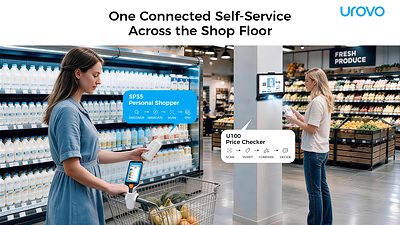
As retailers balance rising expectations for convenient in-store experiences with pressure on store teams, they need to make shopping tasks easier to complete without staff assistance. The SP35 extends mobile self-service to the shop floor, while the U100 provides a dedicated shelf-side point for product information and retail services.
"Self-service is moving beyond fixed destinations and becoming part of the broader shopping journey," said Zhang Bo, CTO of UROVO. "Retailers need technology that can meet shoppers where they need information, assistance and transaction capabilities—not simply where a kiosk is installed. SP35 and U100 give retailers a practical way to extend digital capability to more moments in the store, without adding complexity for shoppers or store teams."
SP35 Personal Shopper: Enable More Independent Shopping
U100 Price Checker: Bring Product Information to the Shelf
Together, SP35 and U100 extend self-service across the shopping journey, helping retailers handle routine product, pricing and payment interactions with less staff intervention while allowing store teams to focus on higher-value shopper service.
Meet UROVO at NRF 2026: Retail's Big Show Europe
UROVO will showcase SP35, U100 and its connected retail portfolio at NRF 2026: Retail's Big Show Europe, Sept. 15–17, at Paris Expo Porte de Versailles, Hall 6, Booth B-020.
About UROVO
Founded in 2002, UROVO is a global provider of enterprise mobility and digital business solutions, specialising in barcode, RFID, mobile computing, printing and payment technologies. Visit: UROVO.
Media Contact
claire.bell@urovo.com
 View original content to download multimedia:https://www.prnewswire.co.uk/news-releases/urovo-launches-sp35-and-u100-to-extend-self-service-across-the-shop-floor-302871163.html

Die Innenministerkonferenz (IMK) der Länder hat ihr seit 1954 praktiziertes Einstimmigkeitsprinzip aufgegeben und setzt künftig auf Mehrheitsentscheidungen. Beschlüsse gelten nun als gemeinsame Linie der Länder, wenn mindestens 13 der 16 Innenministerinnen und Innenminister zustimmen. Die Neuregelung wurde nach Angaben eines Sprechers des Gremiums im schriftlichen Umlaufverfahren beschlossen und gilt ab sofort.
Auslöser für den Kurswechsel ist die Möglichkeit, dass in kommenden Landesregierungen die AfD das Innenressort übernehmen könnte. In Sachsen-Anhalt hatte ihr Spitzenkandidat Ulrich Siegmund zuletzt erklärt, er wolle sich im Dezember zum Ministerpräsidenten wählen lassen – ein Schritt, der eine Regierungsbildung mit AfD-Beteiligung als realistische Option erscheinen lässt. Nach der bisherigen Praxis hätte ein Land mit einem AfD-Innenminister im Zweifel IMK-Beschlüsse blockieren können.
Mit der Abkehr von der Einstimmigkeit wollen die übrigen Länder nach übereinstimmenden Angaben verhindern, dass ein einzelnes Ressort – unabhängig von der parteipolitischen Farbe – zentrale Positionierungen in Fragen der inneren Sicherheit ausbremst. Bislang sollte die Einstimmigkeit sicherstellen, dass kein Land bei sensiblen Themen überstimmt wird; ein Veto oder auch eine Enthaltung konnten Beschlüsse stoppen, abweichende Positionen wurden im Protokoll dokumentiert. Künftig soll bereits eine breite, aber nicht mehr vollständige Zustimmung als ausreichend gelten, um einen länderübergreifenden Standpunkt zu formulieren.
Formal bleibt die IMK ein informelles Gremium ohne gesetzliche Grundlage. Sie ist weder im Grundgesetz noch in Bundes- oder Landesgesetzen verankert und verfügt über keine geschriebene Geschäftsordnung. Gleichwohl entfalten ihre Beschlüsse beträchtliche Wirkung, weil sie in den Ländern politisch aufgegriffen und umgesetzt werden. Mit der nun eingeführten Mehrheitsregel verschiebt sich das Machtgefüge innerhalb dieser Runde: Konsens bleibt möglich, ist aber nicht mehr Voraussetzung dafür, dass die Innenminister gemeinsam handeln.




